

Let’s skip the preamble. You want to know what AI SEO costs, whether what you’re being quoted is reasonable, and what separates pricing that reflects genuine value from pricing that’s just inflated because “AI” is in the name.
Here’s what the market actually looks like in 2026, with enough context to make the numbers useful.
The Pricing Landscape: A Real Range
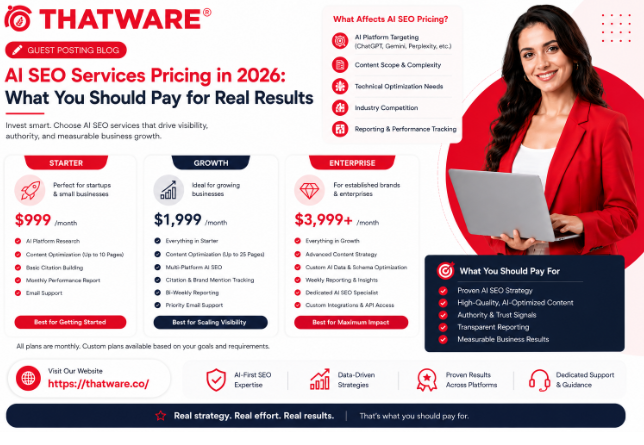
AI SEO services pricing varies widely, and the variation isn’t random — it tracks fairly closely with scope of work, agency capability, and client complexity. Here’s a realistic breakdown by tier:
Starter/boutique tier: $2,500–$5,000/month. This typically covers smaller sites (under 500 pages), less competitive niches, and a relatively focused scope — semantic audit, content strategy guidance, basic entity optimization, monthly reporting. The AI methodology is present but not running at full depth. Appropriate for businesses in earlier stages of organic search investment or in niches where competition is manageable.
Mid-market tier: $6,000–$15,000/month. The bulk of serious AI SEO engagements fall here. You’re getting full semantic entity mapping, probabilistic intent modeling, content graph architecture, technical SEO integration, and ongoing performance monitoring against AI-specific metrics. Client profile: established businesses in competitive niches with significant organic search opportunities.
Enterprise tier: $15,000–$50,000+/month. Large sites, multiple product or service verticals, highly competitive commercial niches, complex technical environments. At this tier, you typically have a dedicated team rather than shared resources, comprehensive cross-property semantic strategy, and often integration with paid search and content marketing strategy.
Project-based pricing: $8,000–$30,000 per project. Some agencies offer a project-based semantic audit and architecture engagement — a one-time deep dive into your semantic entity coverage, gap analysis, and content architecture recommendations — followed by an optional ongoing retainer. This model suits businesses that want strategic clarity before committing to ongoing spend.
What Drives AI SEO services pricing / cost of AI SEO services Higher
Several factors push pricing toward the upper end of any tier:
Competitive intensity. The more competitive your niche AI SEO services pricing / cost of AI SEO services — the more established players you’re competing against for high-value queries — the more intensive the probabilistic modeling and entity optimization needs to be. Financial services, healthcare, legal, enterprise SaaS, and e-commerce in competitive categories all push pricing upward.
Site scale and technical complexity. A 10,000-page e-commerce site with legacy architecture requires substantially more audit, remediation, and ongoing architecture work than a clean, well-structured site of 200 pages.
Existing content baseline. Sites with large existing content libraries that need semantic restructuring require more initial investment than sites where content is being built from scratch to a new architecture.
Agency specialization and reputation. Agencies with documented results in your specific vertical — and the reputational leverage that comes from that — typically command premium pricing. Often worth it; sometimes not.
What You’re Actually Paying For
Breaking down what a $10,000/month AI SEO engagement actually involves helps calibrate whether pricing is reasonable:
At that level, you’re typically getting 80–120 hours of practitioner time monthly. That time is split roughly between: strategic oversight and analysis (~20%), semantic and content architecture work (~30%), content creation or editing (~25%), technical SEO work (~15%), and reporting/communication (~10%).
The specific allocation varies significantly by phase of engagement. Early months are heavier on strategy and architecture; later months shift toward content execution and ongoing optimization.
If an agency is quoting you $10,000/month but can’t articulate how that time is allocated, that’s worth pushing on.
The Cheap AI SEO Problem
There’s a tier below the ranges above — agencies offering “AI SEO” for $500–$1,500/month — and it’s almost universally not what it claims to be. At that price point, one of two things is happening: it’s traditional SEO with AI branding, or it’s AI-generated content at scale without the semantic architecture that makes AI SEO work.
The former is fine if priced accordingly; you’re just not getting AI SEO. The latter can actually harm your site — thin, poorly structured content published at volume without semantic coherence is increasingly penalized rather than rewarded.
The affordable AI SEO agency question is addressed elsewhere in this series, but the short version: there is a floor on what genuine AI SEO work costs because it requires specialized human expertise. Below that floor, you’re not buying what’s advertised.
Evaluating Whether the Price Is Justified
Rather than evaluating price in isolation, evaluate value. Three questions that help:
What is the revenue potential of the organic search opportunity the agency is targeting? If ranking in the top three for your primary commercial queries would generate $500,000/year in additional revenue, a $150,000/year AI SEO investment has a straightforward ROI story. If the organic opportunity is smaller, the math is different.
What are the projected time-to-meaningful-results, and what does the ramp look like? Months six through eighteen typically produce the most significant returns. What does the agency project at each stage, and is that projection grounded in data from comparable client engagements?
What happens at the end of the engagement? Organic search authority built through genuine AI SEO methodology is a durable asset. Unlike paid search, it doesn’t disappear when you stop spending. The long-term asset value should factor into the ROI calculation.
Pricing that’s justified by honest answers to these three questions is pricing worth paying. Pricing that’s just a confident number attached to vague promises is not, regardless of how impressive the pitch deck looks.